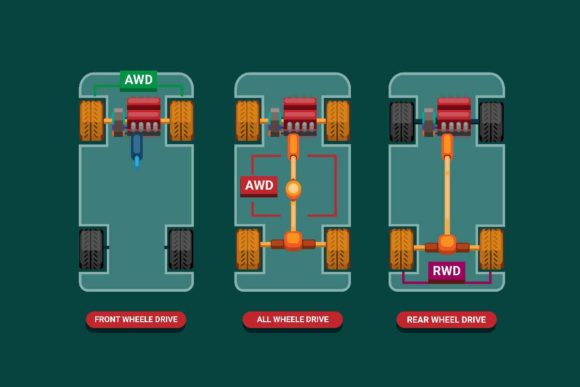
Understanding Car Differences Between Drivetrains FWD Through Visual Design
When evaluating automotive content for educational or marketing purposes, clarity often matters more than technical density. The concept of illustrating car differences between drivetrains FWD, AWD, and RWD through cartoon vector art represents a strategic intersection of mechanical accuracy and visual accessibility. For professionals creating buyer guides, dealership content, or educational materials, this specific visual approach solves a persistent communication problem: how to explain complex torque distribution systems without overwhelming a general audience. Rather than relying on dense engineering schematics or generic stock photography, the cartoon illustration vector format distills mechanical realities into digestible, engaging assets that retain professional credibility while maximizing comprehension.
The Strategic Value of Vector-Based Drivetrain Explanations
The primary strength of using cartoon vector illustrations to depict car differences between drivetrains FWD and their counterparts lies in scalability and adaptability. Unlike rasterized images or photographs, vector graphics maintain perfect fidelity across all mediums, from mobile blog posts to large-format showroom signage. This technical flexibility is crucial for marketers and publishers who need consistent branding across diverse platforms. When explaining Front-Wheel Drive (FWD), for instance, a well-designed vector can isolate the transaxle and front axle assembly with color-coded arrows showing power flow, eliminating the visual noise of engine bays and chassis components that often confuse non-technical readers.
Beyond mere resolution, the stylistic choice of "cartoon" or simplified illustration serves a functional purpose. It creates psychological distance from the intimidation factor associated with automotive mechanics. For an audience of first-time buyers or those researching family vehicles, a stylized representation of FWD versus All-Wheel Drive (AWD) feels approachable rather than academic. This balance is essential for maintaining engagement. The visual style signals that the content is designed for the consumer’s benefit, not just for gearheads, which aligns with modern content marketing strategies focused on user intent and helpfulness.
Deconstructing FWD Characteristics in Illustration
Front-Wheel Drive remains the dominant configuration for passenger vehicles due to its packaging efficiency and cost-effectiveness. When visualizing car differences between drivetrains FWD specifically, effective vector art highlights three key attributes: interior space maximization, fuel economy implications, and understeer tendencies. A high-quality infographic will visually demonstrate how the absence of a rear driveshaft tunnel allows for flatter floors and increased cabin volume. This is a tangible selling point that text alone struggles to convey with equal impact.
Furthermore, illustrating the weight bias of FWD vehicles helps explain their behavior in adverse conditions. Vectors can depict weight transfer during acceleration and braking, showing why FWD cars generally perform adequately in snow but may struggle with traction during hard cornering. For content creators, this provides an opportunity to address safety concerns proactively. By visually representing the mechanical limitations alongside the benefits, the content maintains objectivity. It avoids the trap of presenting FWD as universally superior or inferior, instead positioning it as a practical solution for specific use cases like urban commuting and budget-conscious ownership.
Comparative Analysis: Integrating AWD and RWD Context
Discussing car differences between drivetrains FWD in isolation rarely satisfies user search intent. Readers typically seek comparison. A comprehensive vector infographic concept must therefore integrate AWD and Rear-Wheel Drive (RWD) as counterpoints. The value of the cartoon vector format becomes most apparent here, as it allows for standardized side-by-side comparisons that photographs cannot achieve. When each drivetrain is rendered in the same artistic style, scale, and perspective, cognitive load decreases. The viewer can instantly compare the complexity of an AWD system against the simplicity of FWD without adjusting to different visual languages.
- Visualizing Complexity: AWD systems require depicting additional differentials and driveshafts. Vector art simplifies these components into recognizable icons, making the maintenance and fuel economy trade-offs immediately apparent compared to FWD.
- Dynamics Representation: RWD dynamics, characterized by oversteer and balanced weight distribution, contrast sharply with FWD. Illustrations can use motion lines and vehicle stance to communicate these handling differences intuitively.
- Cost Implications: Effective infographics often include visual metaphors for cost, such as component count or fuel pump icons, helping users understand why FWD vehicles typically carry lower price tags and operating costs.
This comparative approach ensures that the discussion of car differences between drivetrains FWD remains grounded in reality. It prevents the content from becoming a niche technical manual and keeps it relevant to the broader decision-making process of vehicle acquisition.
Practical Applications for Professionals and Creators
For digital publishers, educators, and automotive marketers, the utility of this visual concept extends beyond simple explanation. These assets serve as versatile building blocks for various content formats. A single master vector file depicting car differences between drivetrains FWD, AWD, and RWD can be repurposed into social media carousels, embedded video animations, printable brochures, and interactive web elements. This reusability offers significant return on investment for small business owners and freelancers operating with limited design budgets.
Moreover, the customization potential of vector art allows for brand alignment. Dealerships can adjust color palettes to match manufacturer branding, while independent bloggers can adopt a distinct aesthetic that sets their content apart from OEM literature. This level of control is impossible with licensed stock photography. When explaining nuanced topics like the difference between part-time and full-time AWD relative to FWD, custom vectors allow creators to highlight exactly what matters to their specific audience, whether that is off-road capability, winter safety, or performance driving.
Evaluating Quality and Usability Standards
Not all automotive illustrations are created equal. When sourcing or commissioning vector art regarding car differences between drivetrains FWD, professionals must scrutinize mechanical accuracy alongside aesthetic appeal. A common failure point in cartoon-style automotive art is the misrepresentation of component placement or function. If an illustration shows a driveshaft connecting to a FWD transaxle incorrectly, it undermines the trustworthiness of the entire piece. E-E-A-T principles demand that visual content be as factually rigorous as the accompanying text.
Usability also depends on file structure and organization. High-quality vector assets should feature layered, named groups for each drivetrain component. This allows editors to easily toggle visibility, recolor specific parts, or animate individual elements without reconstructing the artwork from scratch. For those evaluating pre-made asset packs, checking the layer hierarchy is as important as reviewing the thumbnail preview. Poorly organized vectors create more work than they save, negating the efficiency benefits of the format.
Additionally, consider the longevity of the visual style. Automotive design evolves rapidly, but drivetrain fundamentals change slowly. Opting for a timeless, schematic-cartoon hybrid style rather than a trendy, hyper-stylized look ensures the assets remain relevant for years. This is particularly important for evergreen content targeting car differences between drivetrains FWD, where the core mechanical concepts have remained stable for decades despite changes in exterior vehicle styling.
Audience Fit and Limitations
While cartoon vector infographics excel at broad education and top-of-funnel engagement, they have limitations. Enthusiasts seeking deep technical validation or modification guides may find simplified illustrations insufficient. For audiences interested in aftermarket differential upgrades or tuning ECU maps for specific FWD platforms, photographic documentation or CAD renderings are more appropriate. Understanding this boundary is crucial for content strategists. The vector infographic is a gateway tool, excellent for establishing foundational knowledge about car differences between drivetrains FWD, but it should be supplemented with deeper technical resources for advanced users.
The ideal audience for this visual approach includes prospective car buyers, driving students, insurance educators, and generalist automotive writers. These groups benefit most from the abstraction that vectors provide. They need to understand how the system affects their daily experience, not necessarily how to rebuild it. By matching the visual complexity to the audience's actual needs, creators ensure their content remains helpful and relevant.
Ultimately, the decision to utilize cartoon vector illustrations for explaining drivetrain differences should be driven by communication goals. If the objective is to demystify automotive technology and guide users toward informed decisions, this format offers an unmatched combination of clarity, flexibility, and engagement. However, success depends on treating the visuals as integral components of the informational architecture, not merely decorative afterthoughts. When executed with attention to mechanical truth and user experience, these assets transform abstract engineering concepts into practical knowledge, effectively bridging the gap between technical specification and consumer understanding.