Artificial Intelligence Minimal: Visualizing Complex Tech with Clarity
In an era where digital noise is at an all-time high, the ability to communicate complex technological concepts simply has become a premium skill. This is where the concept of Artificial Intelligence Minimal design becomes essential for modern creators and businesses. Rather than overwhelming audiences with chaotic cyberpunk aesthetics or dense technical schematics, minimal AI visualization strips technology down to its functional essence. It bridges the gap between advanced machine learning concepts and human understanding through clean lines, purposeful iconography, and strategic use of negative space.
For professionals seeking to explain algorithms, data processing, or automation without inducing cognitive overload, adopting an Artificial Intelligence Minimal aesthetic is not just a stylistic choice; it is a communication strategy. Whether you are designing an infographic web banner vector for a SaaS landing page or creating educational materials about binary code, understanding how to leverage these simplified visual assets can significantly improve user engagement and comprehension.
The Core Philosophy of Minimalist AI Design
Minimalism in the context of artificial intelligence is distinct from general graphic design trends. While traditional minimalism focuses on "less is more," AI minimalism focuses on "clarity is power." The goal is to represent invisible processes—like neural networks or data encryption—in a way that feels tangible and approachable. When utilizing resources like an Artificial Intelligence Minimal Infographic Web Banner Vector, designers are looking for assets that convey sophistication without intimidation.
This design philosophy relies heavily on specific linear pictograms and illustrations that have become the universal language of tech. These symbols act as cognitive shortcuts, allowing viewers to instantly grasp the subject matter before reading a single word of copy.
Decoding Essential Visual Elements
To effectively implement this style, one must understand the semantic weight of individual icons. A successful Artificial Intelligence Minimal composition typically integrates several key motifs, each serving a specific narrative purpose:
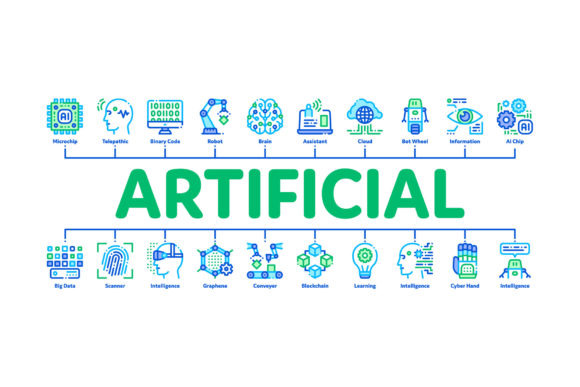
- Binary Code: Often stylized as flowing streams or subtle background textures rather than rigid matrices. In minimal design, binary represents the foundational language of AI without cluttering the foreground. It suggests depth and underlying logic.
- The Robot: Moving away from humanoid or industrial depictions, minimal robots are often abstracted into friendly geometric shapes or simple line art. This reduces the "uncanny valley" effect and positions AI as a helpful tool rather than a sentient replacement.
- Light Bulb Linear Pictograms: Perhaps the most versatile symbol, the linear light bulb represents the "idea" phase of AI. It signifies innovation, problem-solving, and the spark of machine intelligence. Using a linear style keeps it feeling modern and lightweight compared to filled, heavy icons.
- Fingerprint: In the context of AI, the fingerprint rarely refers to biometrics alone. Instead, it symbolizes unique identification, security protocols, and personalized user experiences. It grounds abstract tech in human-centric utility.
- Microchip: The microchip is the anchor of hardware representation. In minimal vectors, this is often reduced to a simple square with radiating connection points, symbolizing processing power and the physical infrastructure supporting virtual intelligence.
- Assembly Line Illustration: This motif translates the concept of automation and workflow optimization. A minimal assembly line illustration depicts efficiency and scalability, making it ideal for B2B contexts where ROI and productivity are the primary messages.
Practical Applications Across Industries
The versatility of Artificial Intelligence Minimal assets makes them applicable across a wide spectrum of professional scenarios. Because these visuals are format-agnostic (typically available in scalable EPS and accessible JPG formats), they adapt seamlessly from massive trade show displays to mobile app interfaces.
Digital Marketing and Web Presence
For business owners and marketers, the primary challenge is reducing bounce rates caused by confusion. An Artificial Intelligence Minimal Infographic Web Banner Vector serves as an immediate hook. When a visitor lands on a page offering AI-driven analytics, a clean banner featuring a stylized microchip and light bulb communicates value faster than a paragraph of text. The minimal aesthetic also ensures that the visual loads quickly and does not compete with call-to-action buttons, maintaining a high conversion focus.
Educational Content and Technical Documentation
Creators developing tutorials, white papers, or internal training materials benefit immensely from this style. Explaining how a neural network learns can be daunting. However, using linear pictograms to map out data flow creates a visual scaffold for learning. The assembly line illustration, for instance, can metaphorically represent data preprocessing pipelines, making abstract engineering concepts relatable to non-technical stakeholders.
Corporate Reporting and Investor Relations
In annual reports or pitch decks, clarity equates to competence. Overly ornate graphics can sometimes signal a lack of substance, whereas Artificial Intelligence Minimal design signals precision and forward-thinking efficiency. Using consistent iconography (such as matching linear styles for fingerprints and robots) creates a cohesive brand identity that reinforces trust and professionalism.
Evaluating Format Suitability: JPG vs. EPS
When sourcing or creating Artificial Intelligence Minimal assets, understanding file formats is crucial for practical application. Most professional packs offer both JPG and EPS options, but they serve different stages of the workflow.
- EPS (Encapsulated PostScript): This is the master format for designers. Because Artificial Intelligence Minimal design relies on crisp lines and geometric precision, vector formats like EPS are non-negotiable for print or large-scale display. They allow for infinite scaling without pixelation and enable color customization to match specific brand guidelines. If you are modifying an infographic web banner vector, always start here.
- JPG (Joint Photographic Experts Group): This raster format is optimized for immediate web use and quick mockups. While it lacks editability, a high-resolution JPG is perfect for social media posts, email newsletters, or blog headers where file size and compatibility take precedence over scalability. For minimal designs, JPG compression artifacts are usually less noticeable due to the solid colors and simple gradients typical of the style.
Strengths and Considerations for Implementation
While the Artificial Intelligence Minimal approach offers significant advantages, it requires thoughtful execution to avoid becoming generic. The strength of this style lies in its universality; however, this same trait can be a limitation if not balanced with unique branding.
The Advantage of Cognitive Ease
The primary benefit is reduced cognitive load. Users process visual information 60,000 times faster than text. By using standardized symbols like the light bulb or microchip, you leverage existing mental models. This allows your audience to focus on your specific message rather than deciphering the graphic itself. In user experience (UX) design, this directly correlates to higher satisfaction and better retention of information.
Avoiding the "Stock Photo" Trap
A common pitfall when using pre-made vectors is the risk of looking indistinguishable from competitors. To mitigate this, treat Artificial Intelligence Minimal assets as a foundation rather than a final product. Combine standard linear pictograms with custom typography, unique color palettes, or proprietary data overlays. For example, integrate your company’s actual workflow metrics into the assembly line illustration rather than using a generic depiction. This maintains the clean aesthetic while ensuring the content remains authentic and specific to your organization.
Balancing Abstraction with Accuracy
There is a fine line between simplification and misrepresentation. While a linear robot icon is excellent for representing customer service chatbots, it may be inappropriate for illustrating cybersecurity threats or ethical AI concerns. Professionals must evaluate whether the minimal metaphor aligns with the gravity and nuance of the topic. Sometimes, a slightly more detailed illustration is necessary to convey seriousness or complexity that a pure minimal icon cannot capture.
Future-Proofing Your Visual Strategy
As AI technology evolves, so too will its visual language. However, the principles of Artificial Intelligence Minimal design are likely to endure because they are rooted in human psychology rather than technological trends. The need to simplify complexity is permanent. By investing in high-quality, scalable assets like infographic web banner vectors and mastering the use of core symbols—from binary code patterns to fingerprint security icons—creators build a visual vocabulary that remains relevant regardless of the next technical breakthrough.
Ultimately, the value of this design approach is measured not by its artistic merit alone, but by its utility. Does it help the user understand? Does it make the technology feel accessible? Does it respect the viewer's time and attention? When the answer is yes, Artificial Intelligence Minimal design has fulfilled its purpose, transforming abstract code into meaningful human connection.