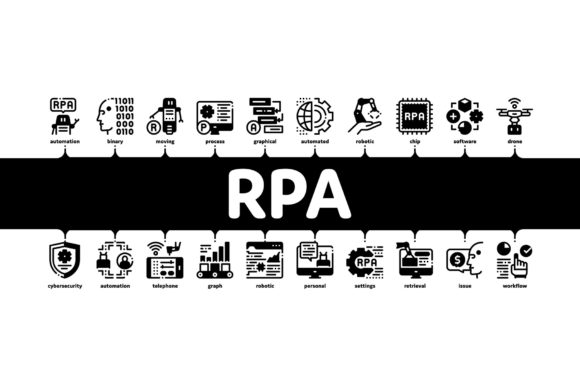
RPA Robotic Process Automation Minimal Design
Visualizing complex technology like Robotic Process Automation (RPA) often presents a unique design challenge. The concept involves invisible software bots, backend integrations, and data streams that lack physical form. When creating web banners, infographics, or presentation decks, relying on cluttered, futuristic cyberpunk aesthetics can actually obscure the message rather than clarify it. This is where RPA Robotic Process Automation Minimal vector assets become essential tools for modern communicators. By stripping away unnecessary noise and focusing on clean lines, these illustrations translate abstract automation concepts into digestible, professional visuals that resonate with business stakeholders and technical audiences alike.
The Strategic Value of Minimalist Tech Illustrations
Minimalism in technical illustration is not merely an aesthetic preference; it is a functional communication strategy. In the context of RPA, a minimal approach reduces cognitive load. When a marketing manager or educator needs to explain how a drone delivers packages via automated routing or how a processor chip handles logic gates, the viewer’s eye should go directly to the workflow, not get lost in excessive shading or gradient effects. High-quality minimal vectors serve as visual anchors. They provide immediate recognition without demanding significant processing time from the audience.
For professionals aged 20 to 50 working across digital and commercial sectors, time is a premium resource. Using pre-designed, cohesive asset packs allows for rapid prototyping of landing pages and whitepapers. Instead of spending hours briefing a designer on the specific look of a robot arm, you can deploy a standardized illustration that maintains brand consistency. This efficiency extends beyond creation; minimal graphics typically have smaller file sizes and render faster on mobile devices, directly contributing to better Core Web Vitals and improved SEO performance for your digital content.
Key Visual Elements and Their Business Applications
A comprehensive RPA illustration suite usually includes specific iconography that maps to real-world automation use cases. Understanding how to leverage these specific elements can elevate your content strategy:
- Drone Delivering Illustrations: These represent logistics automation and last-mile delivery solutions. In a minimal style, the drone is often depicted with simple geometric shapes and motion lines, emphasizing speed and precision over mechanical complexity. This is ideal for supply chain case studies or e-commerce platform headers.
- Processor Chip Graphics: The chip symbolizes the "brain" of RPA. Minimalist versions often use flat colors and negative space to suggest circuitry without overwhelming detail. Use these when discussing AI integration, data processing speeds, or backend infrastructure in fintech and SaaS environments.
- Robot Arm and Hand Vectors: Perhaps the most versatile asset, the robotic arm bridges the gap between physical manufacturing and digital process automation. A clean, articulated arm suggests dexterity and reliability. It works exceptionally well for explaining customer service chatbots, automated data entry, or industrial IoT applications.
These elements are rarely used in isolation. The true power lies in combining them within an infographic layout to tell a sequential story. For example, a horizontal web banner might show a processor chip analyzing data, passing instructions to a robot arm for sorting, and concluding with a drone executing delivery. This visual narrative explains the end-to-end value proposition of RPA far more effectively than three paragraphs of dense text.
Practical Implementation Across Industries
The versatility of RPA Robotic Process Automation Minimal assets makes them suitable for a wide spectrum of users. Freelancers building portfolios for tech clients need these visuals to demonstrate industry relevance without violating copyright by using stock photos of actual proprietary machinery. Educators and trainers rely on clean vectors to create distraction-free learning materials for students studying business process management. Marketers use them to A/B test different value propositions on landing pages, swapping out a "robot hand" for a "processor chip" to see which metaphor drives higher conversion rates.
In corporate environments, these illustrations play a critical role in change management. Introducing RPA to a workforce can generate anxiety about job displacement. Hyper-realistic, humanoid robot imagery can sometimes exacerbate this fear. Minimal, friendly, and abstract representations tend to feel more like tools and less like replacements. They position automation as a supportive utility rather than an autonomous entity. This subtle psychological distinction can improve internal buy-in during digital transformation initiatives.
Selecting the Right Format: JPG vs. EPS
When acquiring or licensing these assets, understanding file formats is crucial for maintaining quality across different media. Most professional packs offer both JPG and EPS options, and knowing when to use each prevents common production pitfalls.
EPS (Encapsulated PostScript) is your primary source file. As a vector format, it is mathematically defined rather than pixel-based. You should always retain the EPS version for any print work, large-format displays, or situations where you need to customize colors to match your brand guidelines. If you are designing a trade show booth backdrop or a high-resolution annual report, the EPS ensures crisp edges at any scale. It also allows you to isolate individual elements; if you only need the drone from a composite scene, you can open the EPS in Illustrator or Affinity Designer and extract just that component.
JPG (Joint Photographic Experts Group) serves as the deployment format for quick digital use. While raster-based and resolution-dependent, high-quality JPGs are optimized for web banners, social media posts, and email newsletters. They require no specialized software to view or insert. However, be cautious of compression artifacts. Always select the highest quality export setting available if you plan to use the JPG as a final deliverable. For responsive web design, consider converting the source EPS to SVG for the web, but keep the JPG as a reliable fallback for older email clients and legacy systems.
Evaluating Quality and Usability
Not all minimal tech illustrations are created equal. When evaluating an RPA asset pack, look beyond the thumbnail preview. Check for consistent stroke weights across all icons; nothing breaks a professional appearance faster than a robot arm with thick outlines next to a drone with hairline strokes. Verify that the color palette is either easily editable or neutral enough to blend with your existing branding. Assess the composition of web banners specifically—ensure there is adequate negative space for overlaying headlines and call-to-action buttons. A beautiful illustration is useless if it forces you to place text over a busy area, rendering both illegible.
Finally, consider the licensing terms relative to your intended use. Commercial projects, client work, and merchandise often require different licenses than personal or educational use. Investing in a properly licensed, high-quality RPA Robotic Process Automation Minimal collection pays dividends by eliminating legal risks and providing a reusable library of assets that grow with your business. By prioritizing clarity, scalability, and strategic relevance, these visual tools transform from simple decorations into integral components of effective technical communication.