Evaluating Hackathon Development Minimal Assets for Professional Event Branding
Selecting the right visual identity for a technology event requires balancing aesthetic appeal with functional clarity. When organizers and marketing teams search for Hackathon Development Minimal resources, they are typically looking for design assets that communicate complex technical concepts without visual clutter. This specific design category focuses on clean lines, ample negative space, and simplified iconography to represent coding, brainstorming, and business collaboration. Unlike generic tech illustrations that often rely on futuristic gradients or chaotic cyberpunk aesthetics, minimal hackathon vectors prioritize readability and scalability.
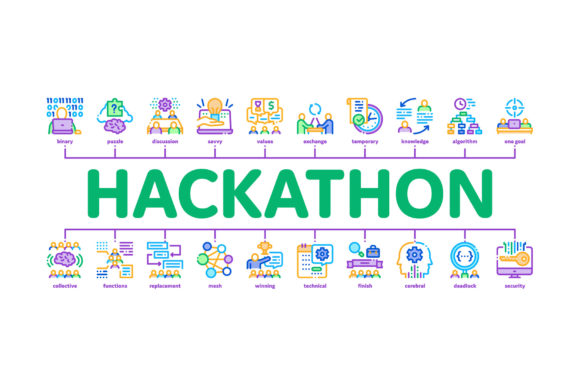
The core value proposition of these assets lies in their versatility. A high-quality Hackathon Development Minimal Infographic Web Banner Vector serves multiple purposes across an event’s lifecycle. It functions as a website header, a social media announcement, a presentation slide background, and printed signage. For professionals aged 20 to 50 who are managing event logistics or leading development teams, the decision to use minimal vector art is often driven by the need for efficiency. These assets reduce cognitive load for the viewer, allowing the essential information—dates, registration links, and themes—to take precedence over decorative elements.
Distinguishing Minimal Vectors from Alternative Design Styles
To make an informed purchasing or licensing decision, it is necessary to understand how minimal vectors compare to other prevalent styles in the tech illustration market. The choice between minimalism and other aesthetics is not merely subjective; it impacts user experience and brand perception.
Minimal Flat Design vs. Isometric Tech Art
Isometric illustrations have long been a staple in SaaS and developer marketing. They offer depth and a sense of architectural complexity that appeals to engineers. However, isometric art can become visually heavy when scaled down for mobile web banners or app icons. Hackathon Development Minimal assets typically utilize flat design principles. This approach sacrifices perceived depth for superior legibility at small sizes. If your primary distribution channel is mobile-first or if you require rapid loading times for a landing page, minimal flat vectors generally outperform detailed isometric scenes.
Abstract Geometry vs. Literal Representation
Some event branding relies entirely on abstract geometric shapes to convey innovation. While safe and modern, abstract art can sometimes fail to communicate the specific nature of a hackathon to non-technical stakeholders or sponsors. Minimal vectors strike a middle ground by using recognizable metaphors—such as simplified brains, lightbulbs, code brackets, and meeting tables—rendered in a reductive style. This ensures that the audience immediately understands the context is "developer collaboration" rather than general corporate innovation or pure data analytics.
Format Considerations: EPS vs. JPG in Event Workflows
When evaluating Hackathon Business, Developer Coding And Brainstorm, Meeting And Idea Illustrations, the available file formats dictate the asset's utility. Most professional packs offer both EPS and JPG, but understanding when to deploy each is critical for maintaining quality.
- EPS (Encapsulated PostScript): This is the source format for vectors. It is infinitely scalable without pixelation. You should strictly use EPS files for large-format printing (banners, backdrops), logo integration, and any scenario where you need to change colors to match specific brand guidelines. Editing capabilities in Adobe Illustrator or Affinity Designer allow you to isolate individual elements, such as removing a character or changing the background hue.
- JPG (Joint Photographic Experts Group): This is a rasterized output intended for immediate use. JPGs are appropriate for email newsletters, quick social media posts, or internal mockups where editing is not required. Relying solely on JPGs limits your ability to adapt the asset later. If a vendor only provides JPGs for a "vector" banner, it is likely not a true vector resource and may not meet professional production standards.
For teams comparing options, verify that the EPS files are properly layered. Some marketplaces sell flattened vectors that are technically scalable but impossible to edit. True Hackathon Development Minimal resources should have separated layers for background, characters, icons, and text placeholders.
Assessing Fit: When Minimalism Supports Event Goals
Not every hackathon benefits from a minimal aesthetic. Evaluating whether this style aligns with your specific event objectives prevents misalignment between branding and attendee expectations.
Ideal Scenarios for Minimal Vectors
Minimalist assets excel in environments where information density is high. If your web banner needs to display a schedule, sponsor logos, and a call-to-action simultaneously, a busy illustration will compete with this text. Hackathon Development Minimal designs provide structured negative space specifically intended for typography overlay. They are also the preferred choice for corporate-sponsored hackathons where the brand identity must remain professional and accessible to HR departments and executive leadership. The clean aesthetic signals organization and maturity, which can be crucial for securing enterprise sponsorship.
When to Consider Alternatives
If your hackathon targets a niche subculture, such as retro-gaming, cybersecurity CTFs, or experimental hardware, minimal corporate vectors may feel sterile or disconnected from the community ethos. In these cases, hand-drawn styles, pixel art, or dark-mode neon aesthetics might resonate more authentically with participants. Additionally, if the goal is to showcase specific technical stacks (e.g., a Kubernetes-specific summit), generic minimal coding illustrations may lack the necessary technical specificity. Always weigh the tradeoff between broad professional appeal and niche cultural relevance.
Practical Evaluation Criteria for Selection
When browsing libraries of Hackathon Business, Developer Coding And Brainstorm, Meeting And Idea Illustrations, apply the following criteria to filter out low-quality or unsuitable options:
- Metaphor Accuracy: Does the illustration accurately reflect modern development? Outdated metaphors (like floppy disks or bulky CRT monitors) can signal that the event is behind the times. Look for contemporary representations of cloud computing, mobile devices, and collaborative whiteboarding.
- Color Customizability: Can the primary colors be changed globally? High-quality minimal vectors use global swatches or CSS-compatible color structures. Avoid assets with hardcoded gradients or raster effects embedded within the vector paths, as these are difficult to rebrand.
- Composition Balance: Test the asset at your intended aspect ratio. Many web banners are ultra-wide (e.g., 1920x600). Ensure the focal point of the minimal illustration remains centered or appropriately aligned when cropped to standard web dimensions.
- Inclusivity and Representation: Modern hackathon branding should reflect diverse participation. Evaluate whether the character illustrations in the pack offer variety in gender, ethnicity, and ability, or if they rely on generic silhouettes that avoid representation altogether.
Integration Strategies for Maximum Impact
Acquiring the asset is only the first step. Effective implementation of Hackathon Development Minimal graphics requires thoughtful integration into your broader communication strategy. Because these assets are designed to be unobtrusive, they pair best with strong typographic hierarchies. Use bold, sans-serif fonts to create contrast against the delicate line work of the illustration.
Consider creating a modular system rather than using a single static banner. Since vector packs often include multiple related elements, you can construct a cohesive visual language. Use the full Hackathon Development Minimal Infographic Web Banner Vector for the main landing page, extract individual icons for the schedule page, and use isolated character illustrations for speaker bios. This consistency reinforces brand recognition across different touchpoints without requiring additional design work.
Furthermore, consider the accessibility implications of minimal design. While aesthetically pleasing, low-contrast minimal palettes can be difficult for visually impaired users to navigate. Always ensure that text overlaid on these banners meets WCAG contrast ratios. The simplicity of minimal vectors makes it easier to add solid color blocks behind text if necessary, without ruining the overall composition.
Making the Final Decision
Choosing between Hackathon Development Minimal assets and alternative styles ultimately depends on your event's maturity, audience, and operational constraints. For established events seeking to project professionalism, or new events needing versatile, editable assets on a tight timeline, minimal vectors offer a high return on investment. They reduce design friction and ensure consistent quality across digital and print mediums.
However, if your priority is cultural signaling over corporate polish, or if you require highly specific technical visualization, you may need to look beyond standard minimal packs. Evaluate the provided EPS and JPG samples against your actual production workflow. Confirm that the level of detail matches your display requirements and that the licensing terms cover all intended uses, including potential merchandise or paid advertising. By focusing on functional fit rather than trend adherence, you can select visual resources that genuinely support the success of your hackathon.